Previous
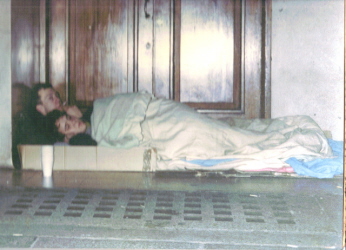
Lee is showing off between the legs of Sabrina, an Italian girl he met on the streets and is now skippering with. He takes her to day centers where he'll conspicuously kiss her in full view of his mates. He says she cries at night and he wants to find a place where they can live together, so we go begging.
 |
We go down to Leicester Square, a tourist spot, and Lee tells me to wander around while he begs and to whistle if I see the police, since begging is illegal. We do this for a while but there are too many police and it's starting to rain. We move to a well traveled alleyway where Lee sits in the doorway saying in his most earnest voice "Excuse me mate ... Excuse me luv ... Spare the price of a cup of tea?" as I sit in a doorway across from him. He keeps up a running commentary about the begging, tells me women are less likely to give and often stop their men from giving, that it's best if you look like scum, and he tries to lower his posture, his demeanor a bit. A black man goes by and Lee begs him. The man very politely says no, "Sorry, haven't got it mate." Lee turns to me, "I hate asking blacks." Later, "Orientals never give you a damn fucken thing." As an almost reflexive response, right after Lee begs someone he turns to me and denigrates them.
"You've got to throw yourselves at them, they'll give up just to get you out of their face. Watch this." And he does throw himself at the next woman who walks by, following her for about 10 steps until she gives him some change. He looks at me proudly.
An old man comes by drunk and offers us some of his can and some begging tips. Lee has no time for him, barely pays attention, takes a few sips off the can and then moves to a doorway around
the corner across from a pub, leaving me with the old man. In a little while I join him as he's cursing some passerby who asked him if he wanted tea and hasn't returned. I huddle behind him in the doorway, sitting on a piece of cardboard, hood on my head, occasionally coughing for effect during his pitch. After about 10 minutes a middle-aged man comes up to us carrying two cups of tea (Lee ordered one for me) in a tray from McDonald's. He very gently places it down, setting us up with stirrers, cream, sugar. I'm overly grateful, almost embarrassed by his consideration. Lee's casual about it. After the man leaves, Lee starts begging again. I point out that he can't use the "Spare the price of a cup of tea" line while he's drinking the tea. He's amused and tries out a few alternatives to see how they sound until we get moved on by a guard.
That's one side of Lee. There's also Lee days later trying to get accommodation, spending the whole night going to advice centers, calling help-lines, waiting for the hostels to open, cowed by the bureaucracy. He's walking the streets almost crying out loud, '"I'm tired of this life, I feel like an old man, I just want to be a normal 20 year old," and then, mostly to himself, he goes off on a non sequitur about the action figures he played with when he was a child.
Or Lee sliding over, patting his blanket when I'm sitting next to him on the pavement, buying cans of Coke for me and his mates with the 36 quid of income support he got that week, playing Ping-Pong at a day center, giddy over a good volley, making corny offers to protect me if something happens ("You run, I'll stay here and fight them off.")
As time goes on, you become less and less afraid of the people you're dealing with, deluding yourself with the fantasy that your past good works are universally acknowledged. And you become more confident that you've earned the right to interfere in their lives without apology. But you also develop that much touted goal of Social Work 101: you start seeing the homeless as individuals. One result, however, is that as individuals the people you meet are no longer protected by the canonical label of "homeless," and you become less democratic in your charity.
There's also the tendency to feel like a hero to the homeless, stepping into the middle of fights (ridiculously thinking, "Hit me instead, I have a home"), breaking rules about giving out blankets at the door, not ousting people for the drugs or alcohol that you see them using in the shelter. You start participating in the slagging off of the charities, accepting drinks off people's cans, trying to rid yourself of the taint of volunteer while still being one.
Among the homeless, as much as there is the need to hate the charity giver, there's a subsequent need to deify as well. People start buying you cups of tea with scrounged money, tell you to keep the 50 pence piece that's thrown from a car window at your feet, thank you over and over for saving their lives. They come up to you, shaved and sober, the day after you found them drunk in a tube station and dragged them back to the shelter, and proudly talk about their plans for a new life. By then you've become almost crazed with loyalty and affection and guilt. And the next day you wade into a crowd of dossers like a messiah.
Click to Continue

