Previous
ccording to Dennis Feld, a lawyer for Mental Hygiene Legal Service (MHLS), the state agency that provides legal representation to patients in psychiatric hospitals, New York State’s Mental Hygiene Law requires that a psychiatrist provide a patient with a form called “Notice of Status and Rights,” as well as explain the legal status of admission, the right to request a court hearing to be released from the hospital, and the amount of time patients can be held under a specific status. They must also provide patients with the name and phone number of MHLS. Woodhull did none of this for me.
I discovered my actual status only when I got up to the ward and read a wall poster explaining the different types of admissions. The doctor apparently admitted me as an “Emergency Admission,” allowing the hospital to hold me for up to 15 days. “Involuntary Admission,” which is how the ER nurses inaccurately described my situation, would have allowed them to hold me for up to 60 days and involves three psychiatrists certifying a patient as mentally ill and a danger to self and others.
In the ER, I had seen a voluntary admission patient ask to submit paperwork requesting release. A nurse told him he couldn’t fill out the form because he wasn’t allowed to have a pen. He had to ask two different workers twice more before he was finally able to complete the paperwork. He was then released.
“Patients have to be told [about their rights] when they come in, not just handed a piece of paper that says ‘You’ve got a right to call a lawyer,’” says Dr. Harvey Bluestone, director of psychiatry at Bronx-Lebanon Hospital and editor of a book on mental hygiene law. “We tell them this is your legal right, here is the lawyer you can call, here’s the number, here’s the quarter to put in the phone. I can’t swear to you what happens at 3 o’clock in the morning, but to the best that I know, this is carried out all the time.
“I think everybody’s got to be given the opportunity to come in voluntarily, and public policy is to encourage people to come in voluntarily,” Bluestone says. “All you need to do to be a voluntary patient is to be mentally competent to sign yourself in....You have to understand what you’re signing yourself into, you have to be able to understand what the exit process is....The psychiatrist who admits you is supposed to very clearly explain that to you--not have a clerk explain it to you. The psychiatrist has to do that, it’s an ethical responsibility.”
hen I arrive on the ward there are approximately 14 other patients. I’m the only white male. Only two or three of the patients are actively delusional. About half are in their 20s. There are two elderly women, two patients whose English is either limited or non-existent and a transvestite, whose arrival is greeted by some patients raging about that homo, that faggot living here. Staff prepare a separate single room for him.
There is a very young black man, Freddy, who has been on the ward for five months--perfectly lucid, funny, with an encyclopedic knowledge of bad TV and films. A few years ago he stopped leaving his housing project apartment, he says, because of the amount of violence he witnessed outside. On the ward, he doesn’t participate in therapy sessions because he thinks they’re ridiculous, and he laughingly says the medication he takes has no effect on him. He spends his days watching television. The day I left, he was sent to a state mental hospital. “It’s real nice there,” a nurse informs him. “They take you downstairs to smoke.”
In the middle of the ward is a large nursing station, a Plexiglas cage with a small opening near the bottom of one window similar to a subway clerk’s booth. Patients sleep, pace the floors, go in and out of their rooms aimlessly. They spend their days being stuffed with television, snacks, medication and cigarettes, begging one another for pay phone quarters.
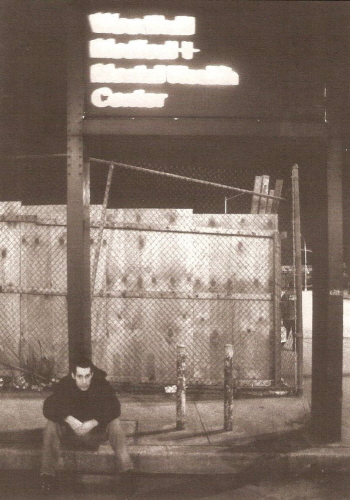 The television, controlled by the twenty-somethings, is constantly on, usually blaring cartoons or action-adventure films. A frail, elderly woman sits on the couch wincing and saying, “Oh, this is so stupid. I don’t care for this. Why do we have to watch this?” Nobody listens. Another elderly woman speaks only Polish and wanders around all day wordlessly or sleeps.
A delusional young woman is pacing around, bumping into walls, half-unconscious (she later complains her medicine is too strong). She wanders into my room, and one of my roommates tries to encourage her to expose herself.
My room contains six beds and a bathroom. When I first arrive the bathroom is completely flooded with water, and I have only my papery foam slippers to walk around with. I tell a nurse, who says she’ll call housekeeping, but the problem isn’t dealt with until the next morning. On other days, patients lay bed sheets on the bathroom floor to soak up the water. My bed sheets and pillowcase are speckled with largish brown stains. The bed frames are dirty, the walls and floor are stained with congealed goo (it looks like either food or blood). What appears to be a rodent hole in the corner is stuffed with toilet paper. The bathroom door is covered with graffiti.
There are no cloth towels. Patients are given a paper towel when coming out of the shower. I’m not given any soap, toothbrush, toothpaste or shower shoes, although I was classified as homeless on admission. There are no locks on any of the cabinets to store possessions (a book I’d been given by a visitor is stolen from me). There is only a pay phone to make calls, but there is no way to get change. If you have change it’s not safe to keep it in the room, and the pajamas and gowns have no pockets. I walk around for the first day or so with quarters in my sock. When I ask staff members for toiletries they respond as though I have irresponsibly tossed out soap I had been given five minutes earlier. I didn’t take a shower for my entire week on the ward; no staff member seemed to notice or care.
It seems anything can be smuggled in through visitors--my visitors’ packages were never checked. Patients in my room regularly smoke contraband cigarettes in the bathroom. In 1995, a patient on a Woodhull psychiatric unit somehow overdosed on methadone, according to an investigation by the State of New York Commission on Quality of Care for the Mentally Disabled, an independent watchdog agency. The hospital investigation never identified the source of the drug but concluded that it “...probably came from an unknown patient or visitor.” This laxity doesn’t seem to be in deference to patients’ rights--I watched a staff member rifle through my roommate’s nightstand drawers when he wasn’t around.
Click to Continue