What makes Sammy run?
Huge and helpless, schizophrenic and hypertensive, Sammy Allen has fallen between the administrative cracks of a local mental health system that can't seem to get its ACT together (continued)
Previous
 |
|
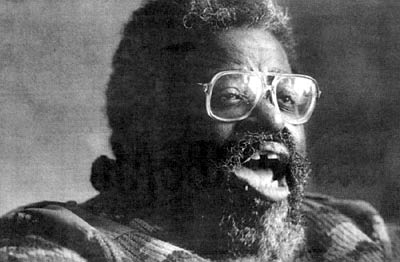
Allen has been repeatedly evaluated as homicidal, violent, and dangerous -- an uberpsychotic. But Allen describes himself as just scared -- and homesick for the safe confines of Terrell State Hospital. |
Allen Sr., a soft-spoken man with a gentle disposition, says that all his children grew up in a religious household (he's a minister who has his own church). One of his other children was admitted to Terrell several times over the years, he allows, but now is fine. Several of his kids are college graduates with stable jobs and families. He remembers nothing remarkable about Sammy as a child, pointing out that he didn't communicate much with his son because he was always working. He refers to Sammy's illness as--literally--an evil spirit or demon, and remains unclear as to when Sammy's problems began, speculating that his son was in his late teens when "he went out of his mind or something." The police, he recalls, picked up Sammy off the streets and took him to the county jail, where he was stripped naked and put in a cell. Eventually he was sent to Terrell.
Sammy himself remembers it differently, claiming that when he was 17, his mother called the police on him because of some dispute. He was taken to jail for the first time, where he remembers shaking and hallucinating. He adds that there were grown men there and that he was just a kid, that the other prisoners harassed him. He describes it as the worst experience of his life.
In a 1977 note in Allen's file, a caseworker described Sammy's mother as screaming at the top of her lungs and refusing permission for a caseworker to visit Sammy at home. "His mother is an agitate to her son," reads the entry. "As I talked to Sammy and tried to help him remember his appt. time and date, his mother taunted him in the background. She was saying he's a mental patient, he needs mental medication."
"My mother loved me," Sammy says now. "She said some things she didn't mean."
"He would do all right as long as he stayed on the medicine that the folks gave him, all that dope that they give him," his father remembers. "Then when he stopped using the dope, he started going back off. And that's been on and on for I don't know how long now...He's been in and out of institutions and jails, that's about the whole story."
Allen Sr. says that Sammy calls from time to time to report his whereabouts, and that he's allowed to come to the house occasionally to pick up his mail.
But for the most part, he acknowledges that Sammy is separated from the family. "I believe he wants to come back here to stay, but I won't permit that," Allen Sr. explains. "Not long ago, my granddaughter was telling me where some mental guy was trying to attack his mother or something and killed his father. I'm not taking no chance on no mental patient staying with me. Mental folk, when they go crazy and act up and kill somebody, all they [authorities] say is [imitates mockingly], 'A mental patient killed his father,' and carry him down to Terrell, keep him two, three weeks, then put him back on the streets. That's what happens with mental people. My son ain't gonna live with me no more."
Given the choice, Sammy says he would spend the rest of his life at Terrell State Hospital. He speaks about the place wistfully, describing it as rural and peaceful. He has friends there, he contends, and groups there to help him control his anger. It is, he notes, a place where he can eat cookies and ice cream. A place for sex, too. Allen talks about the "one-dollar hole" he met in Terrell, a female patient with whom he had sex in the bushes behind the hospital's family center. (A psychiatrist at Terrell State wrote in a recent evaluation of Allen, "This [Terrell State] is probably the closest thing that this patient has to a home.")
The attitude of some in the mental health community toward Allen has been a mixture of resentment, resignation, and skepticism as to whether he has a legitimate psychiatric problem. A number of his clinicians and caseworkers appear to be unclear as to where Allen's psychiatric problems end and his behavioral problems begin. Larry Sadberry, a DMHMR case manager, worked with Sammy from 1993 to 1996 when Allen was living in various apartments in South Dallas--the only period in his history during which he was not admitted to a state hospital. Sadberry states that he was involved in "difficult case conferences" during which doctors were convinced that Allen was faking his mental illness, and that Sammy was a malingerer who should go to jail for his behavior rather than exist as a ward of the mental health system.
A 1985 caseworker report on Sammy Allen reads: "This patient has a very difficult time adjusting outside of the hospital and mainly has only one interest in life and that is being taken care of with regular meals and a roof over his head...He especially enjoys staying in bed, lounging around, and just taking it easy."
Click to Continue


